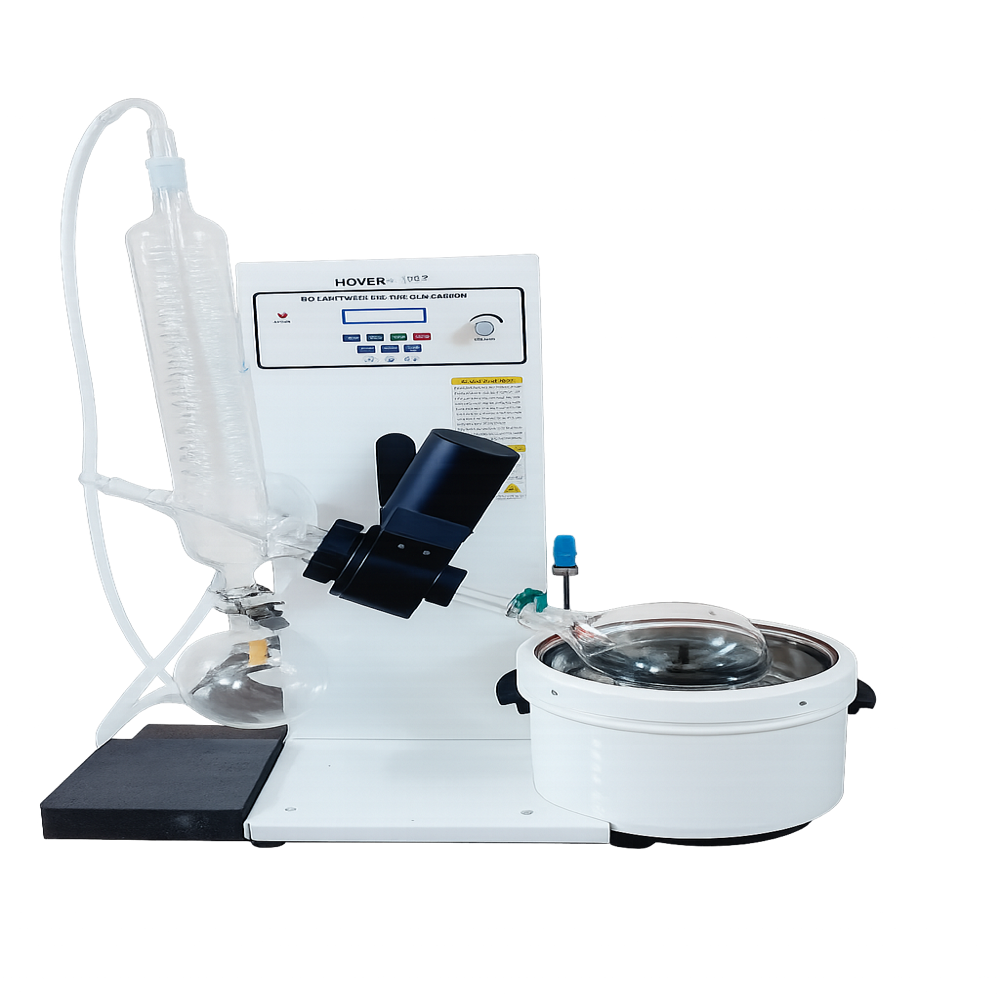
About Rotary Vacuum Evaporator
(Auto lift With Horizontal or Vertical Condenser & supplied with 1 Ltr.
Flask but Capacity is from 50ml upto 3 Ltr.)
16x2 LCD Screen
Digital RPM (20-280) & Timer (00:01 to 99:59) HH:MM
5 Test Profile Save Option
Digital Temperature Controls
for Water Bath (ambient to 200 Deg. C)
Motorised Lifting of Glass Assembly
Advanced Versatility in Laboratory DistillationThis rotary evaporator excels in various laboratory processes, including distillation, concentration, and solvent recovery, thanks to its wide condensing capacity and adjustable flask sizes. The system is ideal for both chemical and pharmaceutical research labs looking for reliability and precision.
Precision Temperature and Control FeaturesEquipped with a digital LCD display and a highly accurate controller (1C accuracy), the rotary evaporator accommodates both water and oil baths with temperature settings from room temperature up to 99C. It supports consistent heating and speed control (20-280 RPM) for optimal operation.
Safety, Quality, and ComplianceConstructed with borosilicate glass (type 3.3), stainless steel, and PTFE materials, the equipment is robust and long-lasting. CE certified and ISO compliant, it features comprehensive protections against over-temperature and over-current, ensuring operator safety and meeting international standards.
FAQ's of Rotary Vacuum Evaporator:
Q: How does the rotary vacuum evaporator facilitate solvent recovery in laboratories?
A: The rotary vacuum evaporator uses controlled heating, a rotating flask, and reduced pressure to vaporize and condense solvents efficiently, making solvent recovery faster and minimizing sample loss in chemical, pharmaceutical, and research laboratory applications.
Q: What is the process for adjusting the flask or receiving flask size?
A: Standard rotary flasks are 2 liters, with options ranging from 500 ml to 20 liters. Flasks can be easily interchanged using standard glass joints (NS 29/32, 24/29, or equivalent) to accommodate varying experimental volumes.
Q: When should I use the water bath versus the oil bath for heating?
A: Use the water bath for applications requiring temperatures up to 99C, as it is ideal for most aqueous solutions and standard laboratory procedures. The oil bath is suitable for processes demanding higher, more consistent heat or for samples that must not dry out quickly.
Q: Where can the rotary vacuum evaporator be installed in the laboratory?
A: It is best placed on a stable, level laboratory bench near a power supply (220-240 V AC) and vacuum source, with sufficient space (at least 640 x 410 x 880 mm) to accommodate its dimensions and allow safe handling of glassware and chemicals.
Q: What safety systems are in place to protect users and samples?
A: The system integrates over-temperature and over-current protections, PTFE vacuum sealing, and a robust digital control interface. These features safeguard users and samples by automatically shutting off the unit in case of abnormal temperature or electrical conditions.
Q: How can I maintain optimal performance of the equipment?
A: Routine cleaning of borosilicate glass components, regular checks on the PTFE vacuum seal, and periodic inspection of electrical and mechanical parts help to ensure consistent, long-term operation while minimizing downtime.
Q: What are the main benefits of using a motorized lift mechanism?
A: The motorized lift enables smooth and precise adjustment of the evaporator flask, reducing manual effort, preventing spills, and ensuring safer, more convenient handling during procedures involving volatile or hazardous solvents.
 Send Inquiry



 Send Inquiry

 Send Inquiry
 English
 Spanish
 French
 German
 Italian
 Chinese (Simplified)
 Japanese
 Korean
 Arabic
 Portuguese