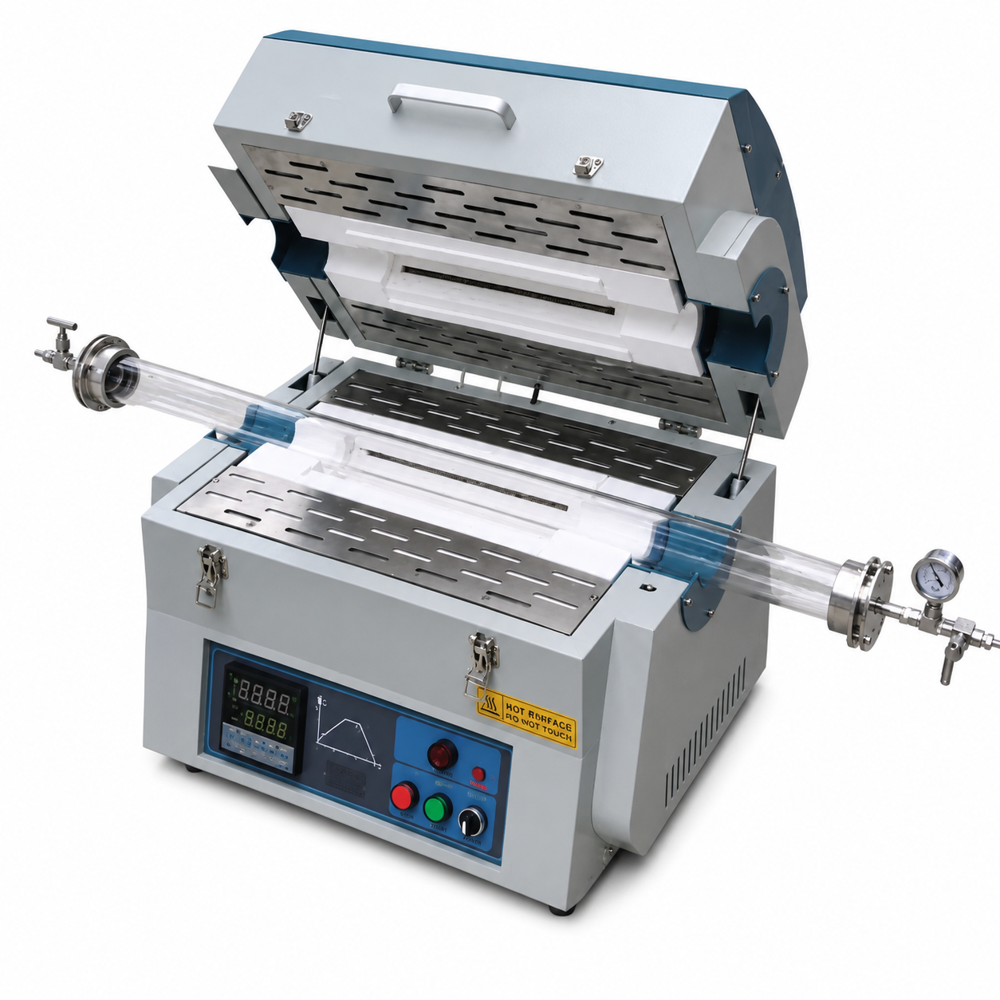
About Split Tubular Furnace
1400 degree working
With PID controller
Quartz 55 x 60 x 1000 mm 2 nos (1000 degree working)
Alumina tube 1400 degree working with SS flange for purging
with Acrylic flow controller.
PID controller 32 step
controller with Thyrsitors and safety latch control
Heating Zone length 300 mm
Power 3 KW, Single phase,
220V, 15 amp current rating/
Pls note: Quartz operating is 1000 degree.
Minimum current 12 amp: 4
square mm wire lining is mandatory
Reliable Heating for Advanced Laboratory ApplicationsSplit Tubular Furnaces are engineered for consistent, high-precision heating, making them ideal for demanding laboratory environments. With digital PID temperature regulation, users achieve 1C accuracy at the controller and 2C uniformity across the working zone. Whether for annealing, sintering, or materials research, these furnaces enable precise thermal processing with programmable controls and rapid heating or cooling capabilities.
Flexible and Safe Laboratory OperationThis furnace's unique split design, available in various tube diameters (25-100 mm), allows easy tube access and cleaning. Built-in safety features, including automatic power cut-off when the door is opened and over-temperature protection, enhance user safety. Flexible atmosphere operation-handling both vacuum and inert gases (upon request)-supports diverse experimental needs.
FAQ's of Split Tubular Furnace:
Q: How do I operate the split tubular furnace for thermal processing or research applications?
A: Operation involves placing the sample within a compatible tube (stainless steel, alumina, or quartz), closing the split-hinged door, and setting the desired temperature via the digital PID controller. Ensure the correct thermocouple type is configured (K or S, as per the model) and safety features are enabled before commencing the heating cycle.
Q: What benefits does the split structure provide compared to fixed tube furnaces?
A: The split design allows users to easily open the furnace from the top or bottom via a hinged mechanism, facilitating quick sample placement, efficient cleaning, or tube replacement. This reduces downtime between experiments and improves overall lab productivity.
Q: When should I choose Kanthal wire or SiC rods for the heating element?
A: Select Kanthal wire for operations requiring temperatures up to 1200C, and opt for SiC rods if higher temperatures-up to 1700C-are needed. The choice depends on your required maximum operating temperature and the specific furnace model.
Q: Where can this split tubular furnace be installed?
A: This unit is designed as a benchtop instrument for indoor, dry laboratory environments. It requires a stable, level surface and access to a 220-230V AC single-phase power supply.
Q: What process controls and safety features does the furnace include?
A: The furnace features a digital PID controller for precise programmatic temperature management, an LED or LCD digital display, automatic power cut-off when the door is opened, safety interlock systems, and over-temperature protection-all designed to ensure safe and accurate operation.
Q: Can the furnace be used in both inert and vacuum atmospheres?
A: Yes, the furnace is compatible with both inert gas and vacuum atmospheres, subject to appropriate tube and flange configuration. Custom options are available to support specialized experimental requirements.
Q: What applications are best suited for this split tubular furnace?
A: Ideal applications include laboratory heating, materials research, thermal processing, annealing, and sintering. The furnace's programmable controls and high temperature resistance make it suitable for a range of advanced scientific and industrial experiments.
 Send Inquiry



 Send Inquiry

 Send Inquiry
 English
 Spanish
 French
 German
 Italian
 Chinese (Simplified)
 Japanese
 Korean
 Arabic
 Portuguese