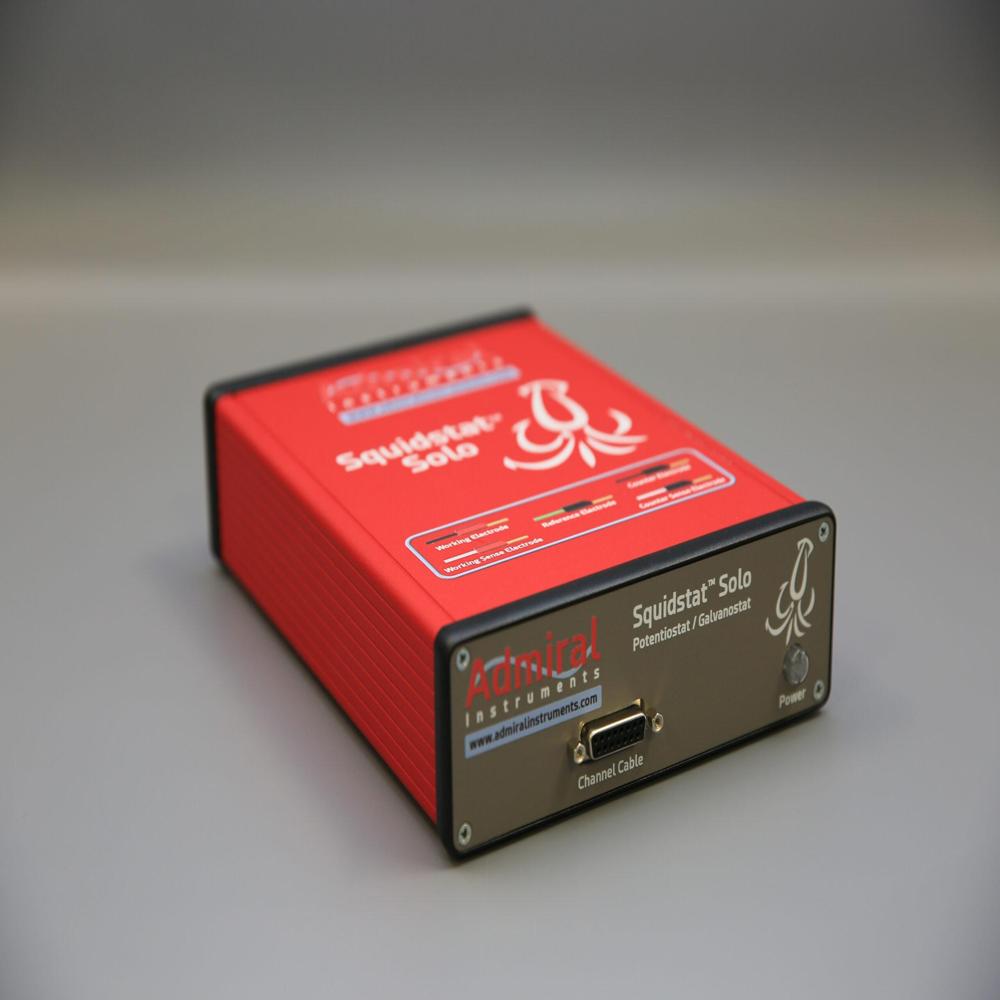
About Squidstat Solo Potentiostat
-
Single-channel potentiostat/galvanostat
-
Current range: 100 mA max
-
Voltage scan range: 10 V
-
Compatible with Windows, MacOS, and Ubuntu via the Squidstat User Interface software and Application Programming Interface
-
Onboard memory (16 GB) automatically backs up all channel data for future recovery
-
Multiple units can run simultaneously with other Squidstat models
-
Made in USA
Versatile Electrochemical AnalysisDesigned for both routine and advanced electrochemical studies, the Squidstat Solo Potentiostat accommodates various research needs, from corrosion studies to battery testing. Its two- or three-electrode configurations enable flexibility for different electrochemical setups. Supporting multiple techniques such as CV, LSV, DPV, and SWV, it helps researchers derive comprehensive data from a single device.
Compact, Robust DesignWeighing just 0.25 kg and measuring only 13 cm x 8 cm x 2.7 cm, the Squidstat Solo Potentiostat fits easily into any laboratory or research station. The anodized aluminum enclosure not only provides ruggedness but also ensures longevity, while its rectangular shape and portable nature make it convenient for field or benchtop use.
Software-Controlled EfficiencyControl and monitor your experiments seamlessly with the Squidstat Software Suite, compatible with Windows, Mac, and Linux systems. The user-friendly interface allows for precise experiment setup, advanced automation, and real-time data visualization, making it easy to operate for both novice and experienced users alike.
FAQ's of Squidstat Solo Potentiostat:
Q: How does the Squidstat Solo Potentiostat connect to a computer for data acquisition?
A: The device connects to your PC or laptop via a USB 2.0 interface. All data acquisition and instrument control are managed through the Squidstat Software Suite, which is compatible with Windows, Mac, and Linux systems.
Q: What electrochemical techniques are supported by this potentiostat?
A: The Squidstat Solo Potentiostat supports a broad range of techniques such as Cyclic Voltammetry (CV), Linear Sweep Voltammetry (LSV), Differential Pulse Voltammetry (DPV), Square Wave Voltammetry (SWV), Chronoamperometry (CA), Chronopotentiometry, and others.
Q: When is it beneficial to use the Squidstat Solo in a laboratory setting?
A: This potentiostat is especially advantageous when portability, a wide current range, and flexible experiment setup are required. Its small size and light weight make it suitable for both permanent laboratory stations and temporary setups, such as field studies or educational demonstrations.
Q: Where can the Squidstat Solo be used considering its operating environment?
A: It is designed for temperature-controlled indoor environments, operating optimally at 0-40C under non-condensing conditions. Its compact build also allows for easy relocation between different workspaces or even outside traditional laboratory settings when necessary.
Q: What is the process for conducting an electrochemical measurement with this device?
A: Connect your electrodes to the potentiostat's 2 or 3 electrode ports, link the device to your computer via USB, and initiate your measurement using the Squidstat Software Suite. The software guides you through configuring experiment parameters, starting data collection, and storing experimental results.
Q: How accurate are the voltage measurements with this potentiostat?
A: The Squidstat Solo Potentiostat offers exceptional voltage measurement accuracy, with typical accuracy rated at less than 1 mV. This ensures reliable and reproducible results across a range of electrochemical applications.
 Send Inquiry



 Send Inquiry

 Send Inquiry
 English
 Spanish
 French
 German
 Italian
 Chinese (Simplified)
 Japanese
 Korean
 Arabic
 Portuguese