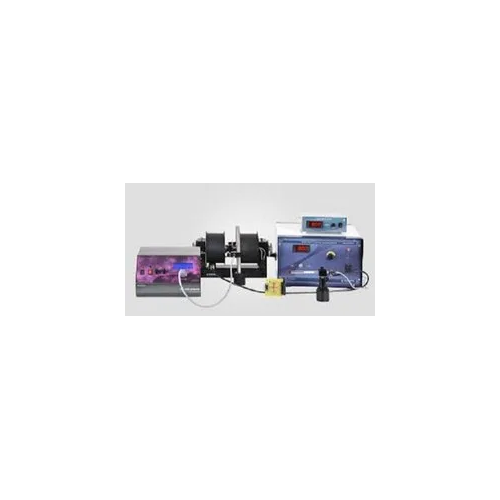
About Hall effect Apparatus
Measurement of Hall voltage as a function of
Accurate Hall Effect MeasurementThis apparatus offers adjustable magnetic fields up to 10,000 Gauss and precise digital readings for both Hall voltage and sample current, making it suitable for research and educational purposes. The digital displays ensure accurate monitoring and recording of experimental data, allowing users to focus on analysis rather than setup. Its robust construction and well-calibrated electronic circuits add to its high-performance capability in laboratory environments.
Versatility and User-Friendly OperationDesigned as a table-top, compact unit, the Hall effect apparatus is easy to set up and operate in any indoor laboratory setting. Featuring intuitive knob controls and a comprehensive instruction manual, it is accessible for users at various expertise levels. The included accessories, such as connecting wires and a Ge crystal sample, simplify the preparation process, enabling quick experimental starts.
Complete Solution for Semiconductor StudiesThis equipment is widely used in physics laboratories for detailed study of semiconductor properties. Its stable electromagnet and temperature resistance make it reliable for experiments that determine key parameters like Hall coefficient and charge carrier concentration. The complete ready-to-use design ensures seamless integration into laboratory routines and teaching modules, facilitating both practical learning and advanced research.
FAQ's of Hall effect Apparatus:
Q: How do I operate the Hall Effect Apparatus for experiments?
A: To operate, first connect the power cord and attach the sample (Ge crystal) using the provided wires. Adjust the electromagnet's field using the control knob. Once the sample is secured and the device is powered, read Hall voltage and sample current from the digital displays as you vary the magnetic field. Consult the instruction manual for step-by-step procedures.
Q: What measurements can be performed using this apparatus?
A: The apparatus allows measurement of Hall voltage (0-20V) and sample current (0-20V), which are essential for determining the Hall coefficient, type of charge carriers, and their concentration in a semiconductor sample. It is suitable for fundamental physics and semiconductor studies.
Q: When should I use the Hall effect apparatus in my laboratory workflow?
A: This equipment is ideal for experiments that require accurate determination of semiconductor properties, such as Hall coefficient and carrier concentration. Use it during laboratory classes, demonstrations, or research sessions focusing on material science and condensed matter physics.
Q: Where can this apparatus be installed and used effectively?
A: The device is designed for indoor laboratory environments and fits comfortably on most standard laboratory tables, thanks to its compact size (300 x 200 x 150 mm). Ensure installation in a dry, room-temperature setting for optimal performance and longevity.
Q: What is the process for measuring carrier concentration using the Hall Effect Apparatus?
A: Begin by mounting and connecting the Ge crystal in the sample holder. Power up the apparatus and gradually increase the magnetic field. Record the Hall voltage at different field strengths from the digital display. Using the measured voltage alongside known values and equations provided in the manual, you can calculate the carrier concentration.
Q: How does the apparatus ensure accuracy and safety during use?
A: This Hall Effect Apparatus employs digitally controlled voltmeters and ammeters with 1% full-scale accuracy. Its durable powder-coated MS body, quality components, and compliance with standard laboratory safety norms help provide a safe and reliable experimental environment.
Q: What are the main benefits of using this Hall Effect Apparatus?
A: The main benefits include user-friendly operation, accurate and stable measurements, ready-to-use design with all accessories provided, and durable construction. It streamlines the study of semiconductor properties and enhances both teaching and research in physics laboratories.
 Send Inquiry



 Send Inquiry

 Send Inquiry
 English
 Spanish
 French
 German
 Italian
 Chinese (Simplified)
 Japanese
 Korean
 Arabic
 Portuguese